It isn’t just Cardiff that is facing a music decline, all of Wales and England have been suffering from the same problem. With 35% of England’s Live Music venues shutting down between 2005 – 2017.
Here is a response from the Music Venue Trust Charity about the Welsh inquiry regarding the music industry in Wales.
According to The Guardian, the recent decrease of interest in Live Music has resulted in the very slow death of many music venues throughout England and Wales. It is stated that the venues closed due to the changes with time, under new strict licensing laws and a bigger increase in property value has left many elder venues on the verge of shutting and some being shut down all together.
Bethan Sayed AM of Plaid Cyrmu put this whole situation best “We’re at risk of losing our thriving live music industry for the next generation.”. You can find out about Bethan Sayed AM in the Research Tab under important people.
I interviewed my dad, you can find his interview in the interview tab, he brings up some important points since he isn’t originally from Cardiff, he is from Caerphilly.
In schools all over Wales, according to the BBC, there has been an evident 40% drop in students who take music as an option and that this hasn’t happened overnight. The decline in students has been ongoing for 10 years. The course is said to not get the same amount of respect as other subjects like mathematics, English and science and this has spread onto Welsh colleges as only small numbers of students are taking A-Level music or music-related subjects.
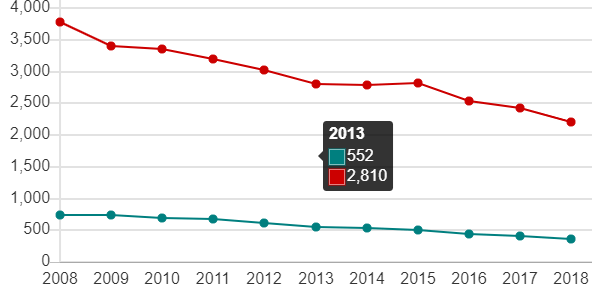
Here is a graph from the article above that depicts the number of students taking music at GCSE and A-Level, the decline is obvious and ongoing even today. This is something that I have witnessed, for one, I took Music during my GCSEs and only seven students attended, one being my best friend. I went on to study Music Technology in College where only 10 people attended, my best friend went onto to study music and found that the numbers were less than 15.
A Petition went out to the Welsh Assembly, which can be found here, that claimed Wales was losing its musical reputation and identity, a thing further claimed to be vital as Wales has always been a musical country. It is often stereotyped that all Welsh people can sing, we are prideful of our national identity and we belt out the national anthem with pride.The Petition wanted this
- The Music Services in Wales are integral to the development of Music Education as part of the creative curriculum across all domains.
- The contribution made by the Music Industry and Music Services to the economy and the well-being of the people of Wales is too important to ignore.
- Young people in Wales studying music at A-level has halved in 10 years while GCSE entries have fallen by 40%.
- Austerity is not an excuse for the Welsh Government to allow the decline of Music Services. Austerity should be the reason to invest in the equality of access for all and the sustainability of our communities.
The petition recieved a total of 1743 signatures as of
17/05/2019.
According to merriammusic it claimed that there are four major reasons as to why musical education was really getting cut from schools. These are
- School leaders are not innovative
2. The value systems in schools are outdated
3. Existing music programs are under performing
4. Myopic approach to budget constraints
The biggest problem, no matter whether in England or Wales, is budget and the fact that many people cannot afford their own musical instrument and rely on the school to provide for them. For example here are the average prices for the following categories of classical and modern instruments.
Woodwind (According to johnpacker.co.uk/)
- Oboe: £400 – £8,000
- Flute: £125 – £10,000
- Clarinet: £93 – £25,300
- French Horn: £251 – £5,600
- Piccolo: £345 – £2,700
- Saxophone: £93 – £9.600
Brass (According to johnpacker.co.uk/)
- Trumpet: £127 – £4,250
- Cornet: £99 – £3,879
- Mellophone: £509 – £539
- Trombone: £100 – £8,550.00
- Tuba: £789.00 – £8,900.00
String
- Violin – (According to gear4music) £39 – £3,000
- Viola – (According to gear4music) £104 – £2,200
- Cello – (According to gear4music) £160 – £3,900
- Guitar: (According to pmtonline) £59.00 – £5,399.00
- Electric Guitar: (According to pmtonline) £79 – £15,769.00
Percussion
- Drums: (According to pmtonline) £239.00 – £6,629.00
- Xylophone: (According to gear4music) £20 – £1,750
As you can see, it is fairly expensive to play the more popular instruments and even learning to play the more cheaper xylophone will eventually cost you more money. Even singing lessons are expensive, as somebody who does sing occasionally and have performed publicly, I always dreaded the cost and at first didn’t bother to attend singing lessons. When discovering that singing lessons were free during my GCSEs I attended and sang Broadway songs in alto-soprano, however, I was once again disheartened to see that to carry on singing outside of my education would cost me money that I didn’t have.
The lack of interest could also be blamed on the current talent in the music industry, or simply because of the future of the music industry. Becoming famous has become a lot harder, but also easier due to YouTube and other streaming sites.
According to Vice, if the UK were to lose its smaller venues, then it wouldn’t have a musical identity and cities like Cardiff thrive from the small venues influence of bringing in tourists. The country has already taken a substantial blow with the loss of some of the most important and successful live music venues, including Gwihiw in Cardiff.
According to the Independant in 2018, the UK music industry warns that we are currently under a lot of risk with serious problems within the live music industry. It fears that we could lose a lot of reputation if grassroot live music venues continued to close down, which currently in 2020 they still are with Ten Feet Tall and Undertones on the current list to lose their Live music venues.
According to the BBC in 2018, the shutting down of music venues is making Britain poorer. Furthermore, in 2019, Live Music in the Midlands have been noted to be in decline, this is according to artsprofessional. But, according to the Prime Minister of London in 2019, he claims that there has been a rise in the number of live music venues in London, but he is referring to the LGBTQ+ venues in London. You can find more about this on the London.gov website.
Coronavirus
Recently, with the outbreak of Coronavirus, Live music musicians have been greatly affected as many make a living off playing music live at weddings and parties. According to the BBC, self-employed musicians are already suffering beneath the quarantine in both Northern Ireland and Britain. On the article is a video. According to the news, all weddings and big events such as Glastonbury, have been cancelled and postponed with many weddings being allowed to only have 5 people in attendance of the ceremony.
It is believed that every part of the music industry will be affected massively by the outbreak and already some popular artists have already died from it including, Adam Schlesinger who was the co-front-man of the band Fountains of Wayne, the musician Alan Merrill who was the original singer for the song ‘I Love Rock and Roll‘, and Joe Diffie who was a famous country-music singer.
According to The Guardian, ‘there is an entire infrastructure of aspiring musicians, session players, sound engineers, booking agents, record shop owners, DJs, labels, tour managers, event staff and more whose livelihoods are at risk with venues closing their doors, and with Boris Johnson saying venues can stay open but advising people to stay away, fear in the industry quickly turned to anger.’ With one person stating that ‘The Government is shafting us’ and that they wished that they had been told properly on what to do and that they feel that the Government is a complete disgrace. Another person stated that he compared the virus to the feeling of when 9/11 happened because of just how scary and devastating it is. A lot of people are devastated that their livelihoods are being interrupted or ruined because of the virus and lack of proper action being taken to ensure that artists and the people behind events have money to fall back to.
According to KCRW, they state that in order to ensure that musicians to remain relevant and present is to buy their albums and merch. It is best to buy these items online, which is far better than going to HMW or music shops. They also suggest that people should donate their old albums and tickets and just donate money directly to the artist. They also suggest donating to live music venues and sharing the music amongst friends and families. For the artists, they suggest that they should keep track of their loses and ensure that they apply for relief.
According to econsultancy, it has been noted that interest in music streams have decreased and even Spotify has noticed a large decrease of interest in their Top 200 chart with a 11% decrease in views.
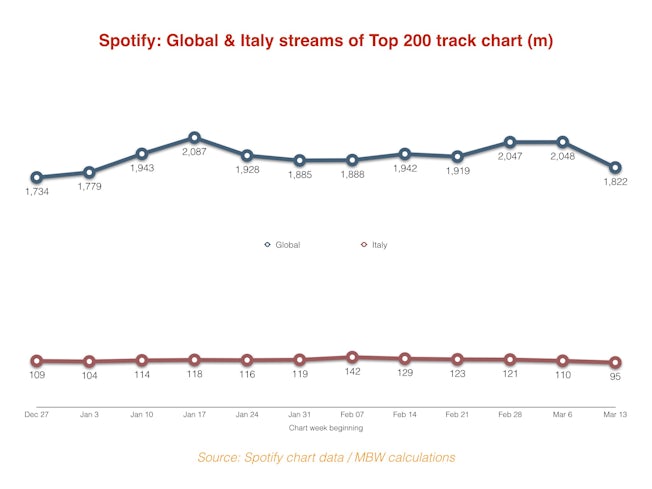
There is a very large decrease of interest.
 ChloeMusicScene